
A Play For Life: 2050
A Day on the Common Planet


For four parts, we’ve been working at the level of systems: ledgers, trust layers, the mechanics of how credit works, and why the window is open now.
But systems are just the rules people live inside.
This is a story about the people and life one day in 2050, after the transition — three lives, three cities, a planet that got the architecture right. This is what it feels like to wake up inside it.
Before
In 2029, Marcus processed insurance claims in a Manhattan tower, forty-one floors above a city he couldn’t afford to live in. He was good at his job. He was also, on some level he rarely examined, aware that his job existed primarily to find reasons not to pay people what they needed. He didn’t dwell on this. The rent was due.
On his breaks he scrolled. The feeds knew exactly what would keep him there — not what he valued, but what would hold his attention for a few more seconds. He told himself it was rest. It wasn’t.
In 2029, Lucía taught third grade in Oaxaca for a salary that required her to tutor evenings and weekends just to make rent. She loved her students. She was exhausted. The first thing she reached for every morning left her more tired than when she woke up. She doesn’t remember exactly when that stopped. Only that it did.
In 2029, Jin-ho ran quality control at an electronics factory outside Busan. He knew the machines better than anyone. He also knew they were designed to be replaced rather than repaired — not because replacement was better engineering, but because replacement was more profitable. The same logic shaped everything around him: fast, disposable, optimized for throughput rather than care. This bothered him in a way he had no language for yet.
Then came 2030. Then 2034. Then 2036.
The transition didn’t happen the way revolutions happen in stories — all at once, with a dramatic moment. It happened like dawn: gradually, then undeniably. AYU launched in 2030. Communities began mapping their commons onto the ledger. Councils and cooperatives, towns and cities; people began reclaiming housing and infrastructure, converting them from commodity to stewardship. They began receiving Credit, the recognition that they had already been alive, they’d already been contributing, they’d already been owed.
In 2036, Colombia passed the first debt jubilee since Solon had done, 2600 years ago, and when their economy didn’t collapse — when it did the opposite — six more nations followed within eighteen months.
Marcus’s job dissolved in 2040. The entire apparatus of risk-pooling for profit — the actuarial tables, the claim denials, the premium calculations — increasingly became unnecessary when housing was guaranteed and healthcare flowed from communities. He was thirty-three years old with 153,000 Credits, a two-bedroom stewardship in Brooklyn with no rent, no mortgage, no interest, no property tax, no insurance premium, no debt of any kind attached to the place where he slept. It was the first time in his adult life that the place he lived didn’t cost him anything.
For about two weeks he felt the ghost of the old inbox — the phantom urgency of a system that no longer had any claim on him. Then it faded, replaced by something he hadn’t felt since childhood: genuine curiosity about what to do next, with no constraint except what he actually wanted.
He cooked. Badly at first, then obsessively, then well. He took a fermentation class at the neighborhood food co-op and spent three months making things that smelled terrible and tasted extraordinary. He joined a pickup basketball league in Prospect Park — logged on AYU, credited, irrelevant to why he showed up. He took a carpentry module on the Quest Board because he wanted to build a bookshelf and ended up spending six weeks learning joinery with a retired furniture maker in Red Hook. He volunteered as a logistics coordinator for a community composting network and discovered he was surprisingly good at systems that served people rather than extracted from them. He studied urban ecology, learned to swim properly, and read more in two years than he had in the previous decade combined.
Somewhere in the middle of all of it, a group of teenagers started showing up to the park sessions he was running, and he realized he’d become a coach without quite deciding to.
6:20 AM — Oaxaca, Mexico — 2050
Lucía wakes before the house does. The morning is her time — forty minutes before Pilar surfaces, before the day makes its claims. She makes coffee slowly, opens her Visible Hand, and lets the day arrange itself.
The Visible Hand is the interface layer of AYU — the network everyone belongs to now. It doesn’t push notifications or manufacture urgency. It reflects what’s actually there and waits for you to look. Lucía has tuned hers over the years to show what she actually wants: her active Credit streams, the local council agenda, the regional curriculum co-op digest, Quest Board opportunities near her neighborhood, and this morning, a live session from a language collective in Nairobi she joined six months ago, starting in forty minutes.
Her monthly flows landed at midnight: 300 Personal Credit, her baseline, because she exists. Another 100 Community Credit — her democratic share of the collective voice, hers to direct toward whatever she believes deserves it. Below that, her participation streams from yesterday: two teaching hours, a mentorship session, a peer review for the regional curriculum co-op. All confirmed. Credits already distributed.
She checks the Sphere — her feed, shaped by settings she controls, no hidden weighting. A watershed update from the upper valley. A neighborhood forum thread about the Mercado proposal. A research summary from the Society Library on multilingual early education, directly relevant to something she’s been designing for her class. She saves it and closes the Sphere.
She has forty minutes before the Nairobi session. She uses twenty of them sitting in the garden with her coffee, watching the light change over the mountains. Rest and reflection aren’t logged on AYU. That’s not the same as not mattering.
Pilar appears at 6:52, already dressed, tablet under her arm.
“I took the upper valley water quest,” she says. “Flow documentation after last month’s rain. Goes straight into The Ledger of Life.”
Lucía glances at the Visible Hand. Pilar’s activity is already showing — location tagged, time logged, data inputs queued for the watershed model. The quest was posted by the regional ecology co-op. Pilar found it, accepted it, and configured her contribution before breakfast.
“You have school.”
“It’s watershed modeling week. This is school. Ms. Delgado approved it.”
Pilar is thirteen, fluent in two languages and conversational in a third, logging more hours on The Ledger of Life than most adults Lucía knows. Children collect Credits as savings for learning, participating, contributing — not because childhood is labor, but because they’re valued. But for the allowance her mother switched on, Pilar’s Credits wait — untouched by anyone — for her Coming of Age.
“Log your hours properly,” Lucía says.
“I know, jefa.” Pilar is already out the door.
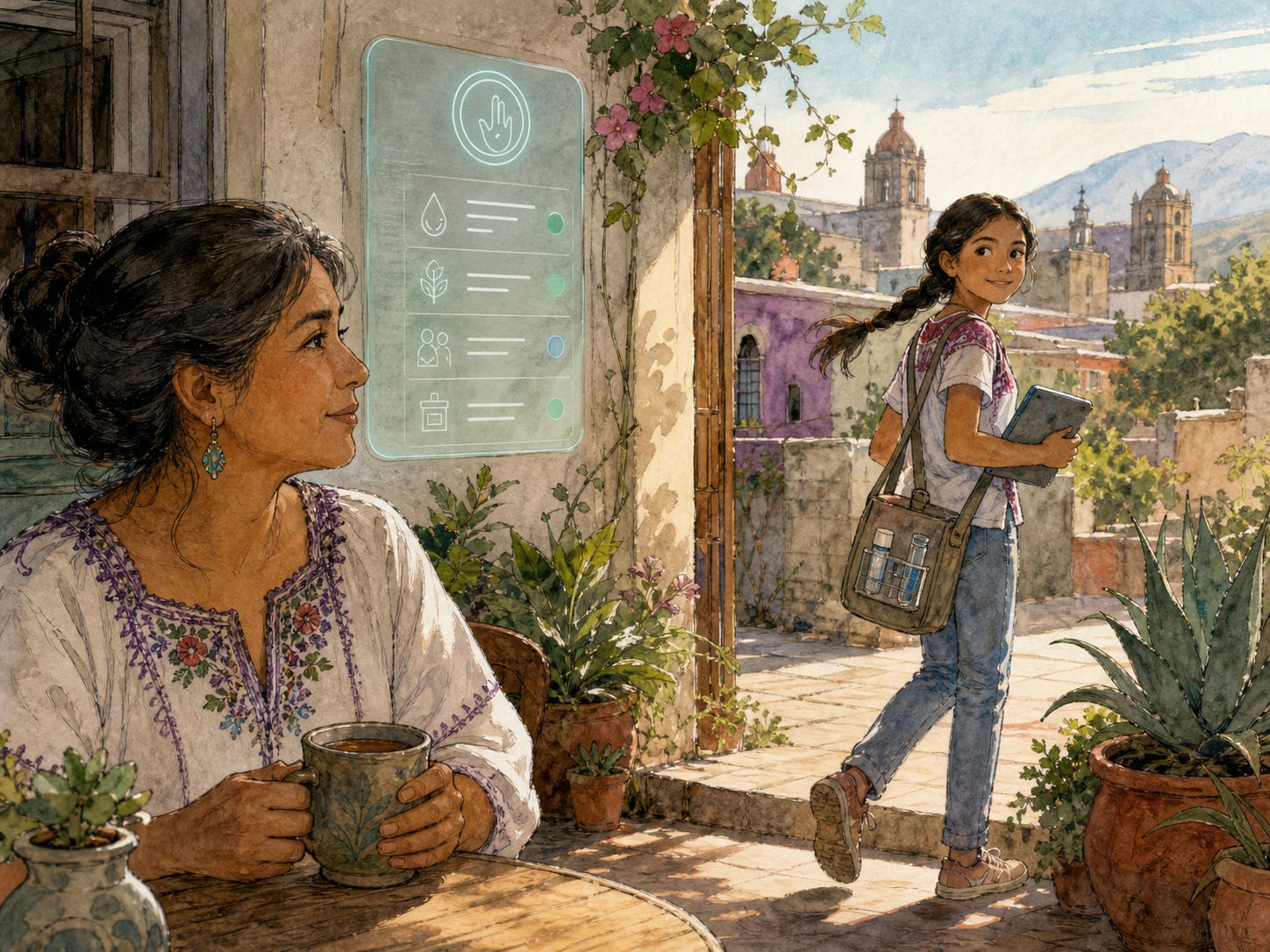
The Nairobi session opens at 7:00. Twelve teachers across four continents, comparing curriculum structures for multilingual classrooms. The Visible Hand offers real-time translation as an optional layer — half the participants use it, half don’t. By 8:30, Lucía has three new ideas for her class, a standing invitation to a Nairobi education co-op’s quarterly gathering, and a small CC allocation incoming from the club’s receipts, split equally amongst the attendees’ cooperative schools wherever they happen to be.
She walks to school through streets where the MarketPlace vendors are already setting up — food co-ops, craft collectives, a repair workshop with a teenager inside doing something careful with metal, a small fabrication studio with its door open. All of it logged somewhere on the Ledger, each contribution recognized, each transaction a small deletion of Credit that was created when the work was done.
7:40 AM — Lagos, Nigeria — 2050
Jin-ho stands in a warehouse that smells of fresh concrete and possibility.
He’s been in Lagos all week, helping a newly formed co-op convert a former import distribution center into a precision components factory. The building was listed on the Lagos community ledger eighteen months ago when the corporation that owned it dissolved, its assets transferred to the local commons. Since then it sat available to any group with a purpose and a plan — free lease on the land, the building, all existing infrastructure. Same principle as a library. You bring the intention. The community provides the means.
The co-op has sixteen members who spent three months drafting their charter on the Talking Stick — the governance tool built into every AYU community with ledgers on The Visible Hand. Voting thresholds, bonus distribution, quality metrics, all of it debated and recorded. Every member equal. Jin-ho read the charter on the flight over and thought it was one of the better ones he’d seen.
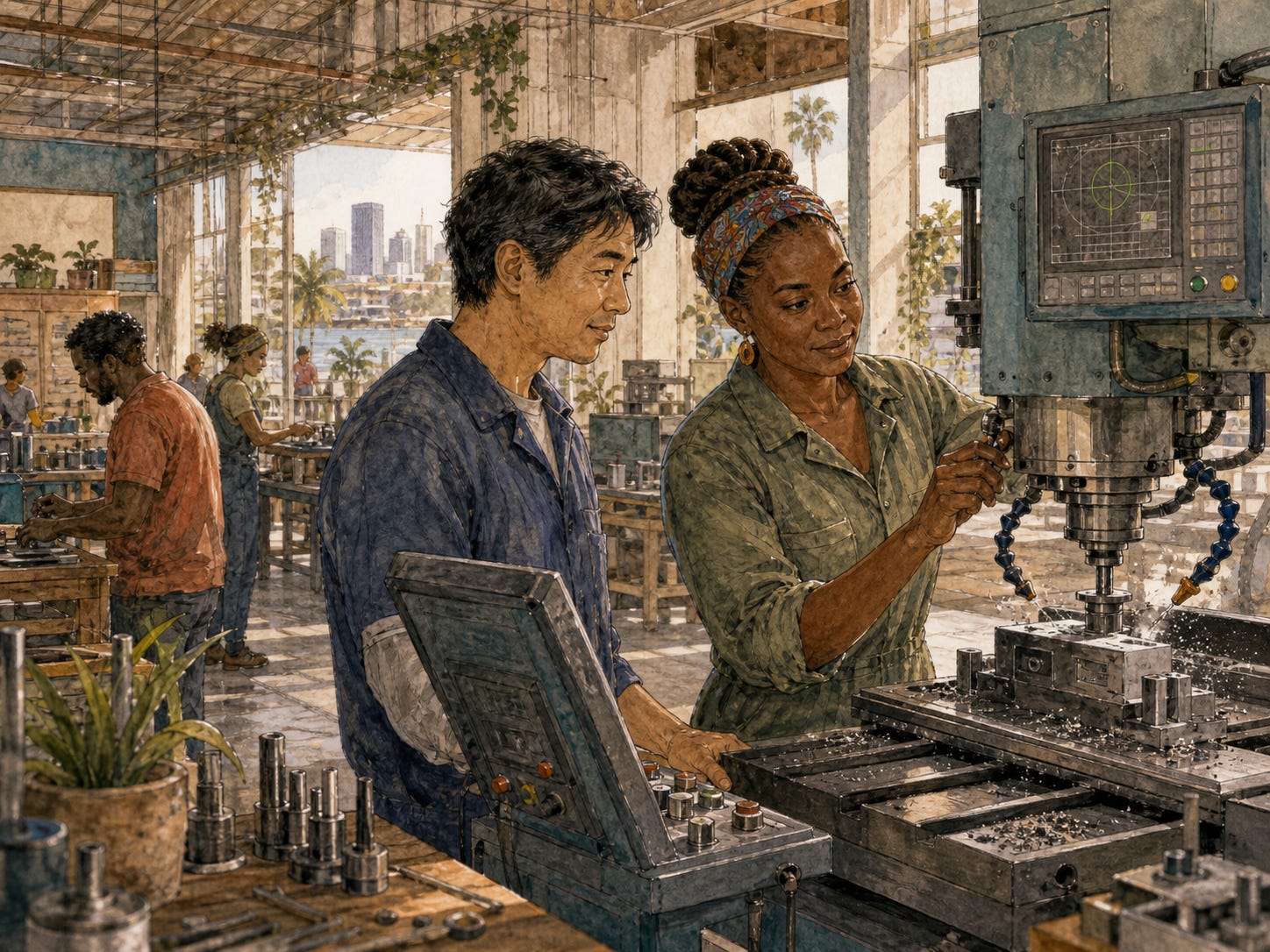
This morning they’re commissioning the CNC milling station — already on the community ledger, previously used by a now-dissolved aerospace co-op, transferred here after the local council approved the request. No purchase. No debt. No lease payment. The machine exists, the community owns it collectively, the co-op stewards it until they don’t need it.
The lead machinist is Adaeze, trained on a similar system in Accra. She runs the first calibration sequence. The numbers drift slightly.
“Thermal expansion,” Jin-ho says. “Humidity’s higher here than Accra. Adjust the baseline compensation by 0.003 millimeters and re-run.”
Adaeze adjusts. Re-runs. The numbers settle. She grins.
Jin-ho’s working life in 2050: five days in Lagos, three weeks in Seoul with Soo-min, two weeks in Bangkok after that. Each engagement earns him a high PC rate — the global standard scale means his skill commands the same rate in Lagos as in Seoul, so no community gets disadvantaged by geography and no worker gets played against another by location. Plus excellence bonuses when co-ops hit their targets.
The apartment in Seoul — a stewardship, no deed, no mortgage, no property tax, just a Housing Level earned through years of good caretaking — stays warm while he travels. Soo-min’s grandmother is there. Homes are for living in.
His phone pulses. Voice message from Soo-min, twelve years old and eight time zones away.
“Appa, I fixed the 3D printer. Filament tension — there’s a whole repair module on the Quest Board. I’ve been working through it for two weeks. Also I showed Halmoni how to list her old sewing machine on the Exchange. Someone in Busan wants it. Also I made too much rice. Okay bye.”
Jin-ho listens twice. Then he goes back to the calibration.
The Exchange is where privately owned goods can be listed and sold for PC at no more than their original purchase price — the only place in the system where Credit moves between individuals. Jin-ho’s mother has three decades of accumulated things from the old world, slowly finding their way to people who need them. Nothing wasted. Everything circulating.
He thinks of the factory outside Busan where his father worked twelve-hour shifts producing electronics designed to fail. He thinks of Soo-min fixing things on a Saturday morning, earning Credit for the skill, adding the repair to her personal ledger of competencies.
Some distances are better measured in what your children have learned.
9:00 AM — New York City — 2050
Marcus is already moving before the group arrives.
His mornings are structured by choice: personal training at six, curriculum prep at seven, field session at nine. He logs the prep hours on the Visible Hand. He doesn’t log the training. Some things are just for living.
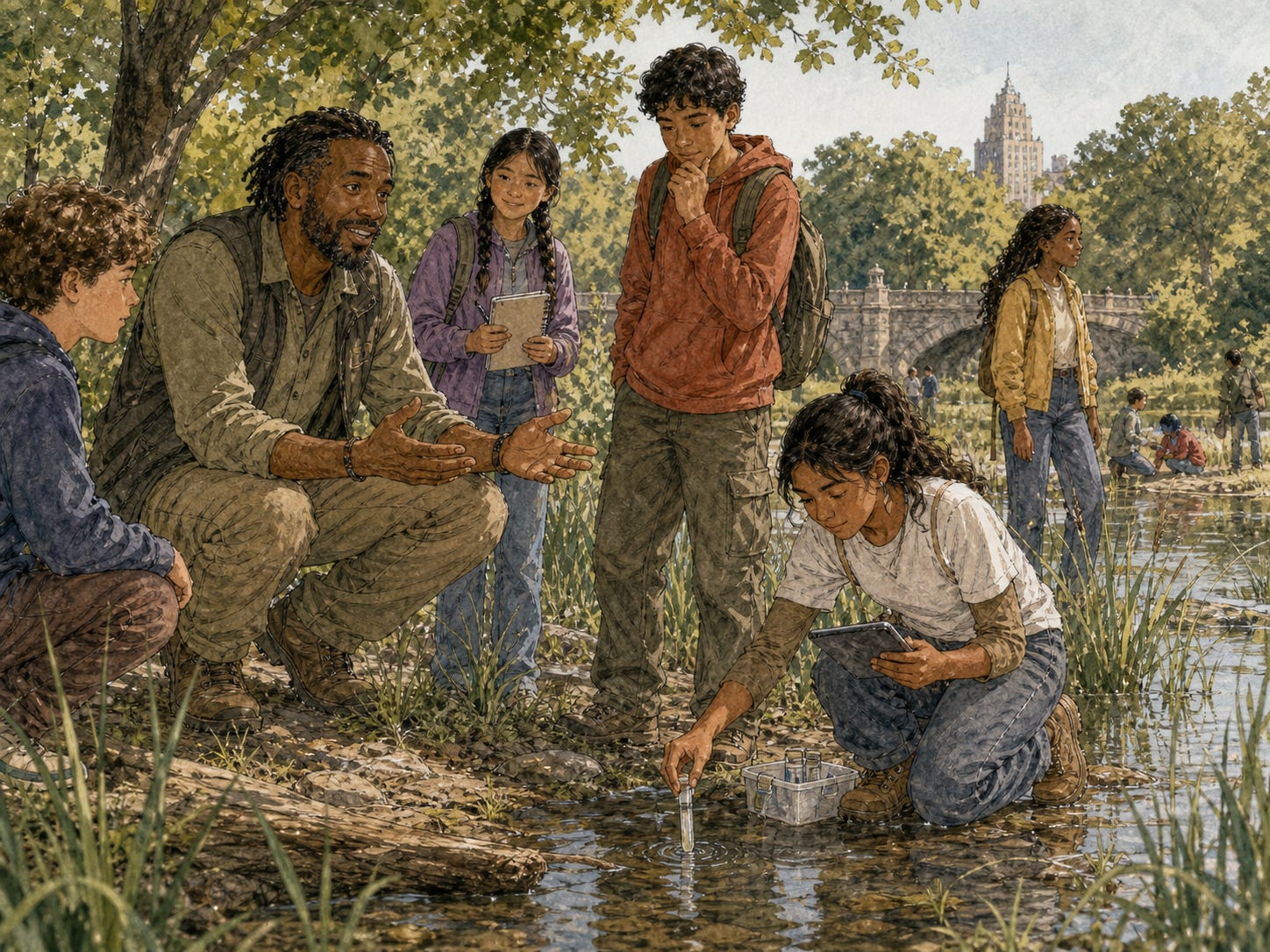
Seven teenagers today — the Wednesday Wander, a loosely structured morning of physical activity, environmental observation, and whatever conversations emerge naturally. All logged on AYU’s Quest Board as educational participation. Everyone earns Credit for being here, including Marcus, whose hourly rate reflects seven years of coaching, curriculum design, and community facilitation.
He used to process insurance claims. He rarely thinks about this in a personal way.
What he thinks about most mornings is how much the old system required managing the consequences of scarcity — paperwork that existed because people couldn’t afford to get sick, systems that existed because people couldn’t afford to lose their homes, feeds engineered to hold attention rather than serve it. All of it was architecture. All of it was chosen. When the choices changed, the architecture dissolved, and what was left was just people — wanting to learn things, make things, be outside, be together.
Amara is at the wetland edge, running water samples for a Quest Board task, logging observations in real time into the Ledger of Life. Tomás hangs back, watching.
“My mom says the internet used to try to make you angry on purpose,” Tomás says.
“Sometimes,” Marcus says. “Angry people stayed longer.”
“Why would anyone build that?”
“It was easy to measure.”
Tomás thinks about this. “That’s insane.”
Marcus doesn’t argue.
His Visible Hand pulses once — he allows certain signals through during sessions. Amazon Headwaters Compact, Year Two completion confirmed. He glances, nods, keeps walking.
He directed 800 CC to the compact three months ago. Millions of others did too, from dozens of countries, each one a separate democratic choice, each one transferred to the co-ops who spent it on the fuel, equipment, and materials the restoration required. The workers who showed up earned their own PC directly, hour by hour. Nobody bought their labor. They claimed it themselves.
He sometimes wonders if the people who contributed alongside him know each other. Mostly they don’t. That’s the point. You don’t have to know someone to care with them.
12:30 PM — Oaxaca Local Council
Forty-one people in the plaza. The Visible Hand shows the agenda on the shared screen, open to every device in the neighborhood.
Three items. The first two pass quickly — a composting network funded by a CC reallocation, a sensor upgrade for the water monitoring stations. The community votes; the Credit moves; the work begins. No tax collector, no distant ministry approving the budget, no waiting to see if the government changes its mind. The CC flowing to community ledgers is the public budget — created directly, allocated democratically, no interest owed, no debt incurred. The local ledger gets 50 CC per citizen per month. The regional gets 10. The global gets 3. Each level governs what belongs to it.
Last month, there was a fourth item — an outdoor theater proposal that never gathered enough CC to move forward. It sits on the Quest Board still, patient. Nobody killed it. Nobody approved it. The community just hasn’t wanted it enough yet, and that’s a legitimate answer.
Lucía explains this system to her students every year. The most useful analogy she’s found: imagine if every citizen got the same number of votes, but instead of voting for politicians once every few years, you voted directly for projects and co-ops every single month — and the votes vanished the moment you used them, so they could never pile up in anyone’s hands. The children get this immediately. Money-as-power, money-that-compounds — that part takes explaining.
The third item is the Mercado building, eleven years vacant, slowly becoming a garden for birds. A proposal for a community kitchen and music venue. A counter-interest from two neighboring towns who want a distribution hub. Four people speak before Lucía raises her hand.
“A kitchen is a distribution point. Let’s co-design it with the neighbors.”
Someone says that’ll take longer. Someone else says it’s waited eleven years. There’s laughter — tired, warm, the kind that means yes.
They vote to open a joint working group. The Mercado will get sorted. These things take the time they take.
Walking home, Lucía opens the Sphere on her Visible Hand and sees the Amazon headwaters notification. She stops in the street. Year Two complete. Water tables recovering. A photograph of a river running clear.
She sends it to Pilar, somewhere in the upper valley with a water testing kit.
This is what votes can do, she writes, when the economy is democratic too.
3:30 PM — Valencia Region, Spain
The alert appears without urgency — nothing in the Visible Hand does unless it’s wanted.
It surfaces quietly across regional materials dashboards and reaches Jin-ho in Lagos because he tagged himself available for ceramics and kiln consultation.
Ceramics Co-op 7B — Resource Performance Flag. Three months CC allocation. Output inconsistent. Two quality benchmarks missed.
He opens the report. Kiln fuel higher than projected. Breakage climbing. Not catastrophic, but not working either.
In Valencia, the co-op’s twelve members are already gathered — six in the room, six in The Sphere notes shared in real time. They know the flag isn’t punishment. It’s signal.
“We scaled too fast.”
“We thought we could hit regional demand in one cycle.”
They pull up the production curve, projected versus actual. The gap is obvious to everyone.
The CC had come from individuals across the region transferring their democratic allocations to this co-op because they believed in the proposal. That part worked fine. The execution didn’t.
The Visible Hand shows their options: continue as-is, request additional CC with new justification, downscale and recalibrate, or open a Quest Board support request.
“Downscale,” the lead says. “Stabilize first.”
“And open the request. We need kiln help.”
The request goes live. Jin-ho sees it, checks the variables, tags himself available in 36 hours.
In Valencia, production targets come down, the CC draw lowers accordingly, and remaining allocation goes toward what actually works. Nothing is seized. The Credit already spent is gone — that’s how it always is. The correction happens forward.
Two weeks later their breakage rate drops by half. A month after that they hit their first quality benchmark. They log the adjustment publicly: what failed, what changed, what worked. Other ceramics co-ops see it immediately. Nobody repeats the same mistake.
6:40 PM — Three Cities, One Network
Lucía eats dinner while Pilar projects watershed data on the wall — live feeds from the upper valley, flowing into a model three co-ops are building together. Pilar talks fast about seasonal flow rates and what they mean for the reforestation plan. Lucía listens and asks questions and learns things from her thirteen-year-old daughter she didn’t know this morning.
In Brooklyn, Marcus sits on his building’s rooftop garden — planted three years ago on bare tar by the residents’ co-op, now producing tomatoes, herbs, and one extremely ambitious squash — reading the full Amazon headwaters Year Two report. Amara texts him a photo of her water sample from the park. Connected, she writes, nothing else. She’s eleven years old and already understands that every data point belongs to a larger picture.
In Lagos, Jin-ho sits on the co-op rooftop and calls Soo-min. His daughter answers immediately, holding up the repaired printer for the camera. Behind her, through the screen, the Han River catches the last of the evening light.
Jin-ho shows her the Amazon photograph. Soo-min looks at it for a while.
“Did our CC go there?”
“Some of it.”
“How much is us and how much is everyone else?”
Jin-ho thinks about this. “You can do the calculations yourself if you like…” he prompts. “We contributed 800 CC. The amount they received from everyone can be seen on the Amazon Headwater Compact’s public account. Our 800 CC divided by the total amount they received equals the percent we contributed. Yes?”
“Yes, that means we contributed four ten-millionths of the credit to their project.” Jin-ho says.
“That’s not very much.” Soo-yin says disappointed.
“Certainly! But almost 3 million people came together because they care about the Amazon, and you, me, and Halmoni are a part of that. And we belong to each other and that part of the world because of it. We need each other to do these kinds of things. We can’t do them alone…”
Soo-min nods, the way she nods when something settles.
9:00 PM — Wherever You Are
The Credit flows for everyone tonight, as it does every night — for farmers and teachers and children logging quest hours, for the retired and the newborn, for people in places once called poor and places once called rich, a distinction that has become mostly archaeological. It arrives like air. It leaves when spent, having done its work facilitating choices.
Personal Credit, spent by individuals on everything the market offers. Community Credit, transferred to co-ops and councils who spend it on the energy, materials, and resources their work requires. Two flows. One system. Both deleted on use. Neither piling up into power over anyone.
Nobody worries about running out. You don’t worry about air.
Across the network tonight: farmers logging harvest data into the Ledger of Life. Builders requisitioning materials from The Marketplace. Students in late-night sessions across continents. Co-ops updating production targets. Councils finalizing votes through the Talking Stick. The Sphere reflecting it all, filtered by each user, shaped by no one else. The Visible Hand showing each person what’s there, waiting.
The old system was also a design — laws, ledgers, deliberate choices — choices that said your existence was a debt, that your economic voice was the size of your wallet, that the rules weren’t yours to act upon. The new system made different choices.
Your existence is not a debt. It is where all value begins.
They call the network AYU. It means Life.
In 2029, Marcus scrolled feeds designed to hold him. Lucía tutored evenings to pay rent. Jin-ho watched machines built to break.
In 2050, their children are outside in the evening, playing, contributing, and shaping a world for one another.
And it is good.
 | A guest post by
|
 | A guest post by
|